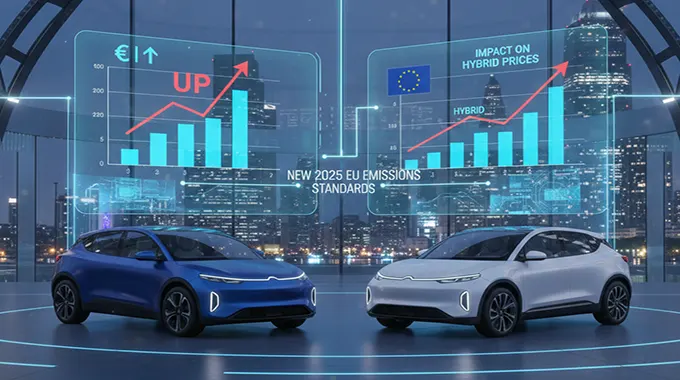
As of January 1, 2025, the automotive industry entered a high-stakes era of “CO2 compliance.” While the headlines have focused on the survival of the internal combustion engine, the immediate reality for consumers is a significant shift in the cost of hybrid technology.
The primary driver of this shift is the Euro 6e-bis standard and the updated WLTP (Worldwide Harmonized Light Vehicles Test Procedure), which have fundamentally changed how hybrid efficiency is calculated.
1. The “Utility Factor” Price Hike for PHEVs
The most direct impact has been on Plug-in Hybrids (PHEVs). In 2025, the EU implemented a revised “Utility Factor,” which assumes that drivers use the electric-only mode less frequently than previously estimated.
- The Result: Many PHEVs that were officially rated at $50\text{g/km}$ of CO2 in 2024 have seen their official ratings jump to $90\text{g/km}$ or higher.
- Price Impact: Because higher emissions lead to higher taxes and potential manufacturer fines ($€95$ per gram over the limit), many carmakers have hiked PHEV prices by €2,000 to €5,000 to cover these regulatory costs.
2. Fleet Averaging and “Banking & Borrowing”
To prevent a total market collapse, the European Commission introduced a “Banking & Borrowing” system in late 2025. This allows manufacturers to average their emissions over a three-year period (2025–2027) rather than meeting strict annual targets.
- The Benefit: This flexibility has prevented an even sharper price spike. If manufacturers were forced to hit the $93.6\text{g/km}$ fleet target strictly in 2025, many would have discontinued affordable hybrids entirely to avoid billions in fines.
- The Cost: Even with this flexibility, the cost of R&D for “greener” hybrid systems is being passed to the consumer, keeping entry-level hybrid prices higher than their 2023–2024 counterparts.
3. The 2035 “Watering Down” and Market Stability
In a major pivot in December 2025, the EU officially dropped the 100% zero-emission mandate for 2035, replacing it with a 90% reduction target.
- Impact on Hybrids: This change guarantees that hybrids and PHEVs will remain legal beyond 2035. This long-term certainty has actually stabilized hybrid prices in the secondary market. Buyers are no longer afraid of “obsolescence,” which has kept resale values high—effectively lowering the “total cost of ownership” even if the initial purchase price is higher.
4. Supply Chain: Green Steel and Batteries
The 2025 standards also introduced credits for using “Green Steel.” Manufacturers can offset up to 10% of their emissions by using low-carbon materials. However, green steel carries a premium price, further contributing to the upward pressure on the MSRP of mid-range hybrid SUVs.
Summary: What Buyers See in 2025
While the EU’s decision to offer more flexibility has saved the hybrid from extinction, the impact of new 2025 EU emissions standards has made the “entry-level” hybrid nearly $15\%$ more expensive than it was two years ago. For consumers, the choice is now between increasingly expensive hybrids or rapidly depreciating traditional gas cars.