Hybrid Battery Cooling System Maintenance Tips to Extend Life Beyond 100k Miles

In 2025, hybrid vehicles are more reliable than ever, but their longevity relies on a single factor: thermal management. The high-voltage battery pack generates significant heat during the rapid charge and discharge cycles of regenerative braking and acceleration. Once your vehicle crosses 100,000 miles, the efficiency of the cooling system naturally declines due to dust and component wear.

To keep your hybrid on the road for another 100,000 miles, follow these critical cooling system maintenance tips.

1. Clean the Battery Air Intake Filter (Every 10,000 Miles)

Most hybrids (like the Toyota Prius or RAV4) feature a dedicated air intake vent, usually located near the rear seats or in the trunk area. This vent pulls cabin air to cool the battery.

  • The Problem: Pet hair, dust, and lint clog the mesh filter over time, starving the battery of air.
  • The Fix: Remove the filter cover and vacuum or use compressed air

Impact of New 2025 EU Emissions Standards on Hybrid Car Prices

As of January 1, 2025, the automotive industry entered a high-stakes era of “CO2 compliance.” While the headlines have focused on the survival of the internal combustion engine, the immediate reality for consumers is a significant shift in the cost of hybrid technology.

The primary driver of this shift is the Euro 6e-bis standard and the updated WLTP (Worldwide Harmonized Light Vehicles Test Procedure), which have fundamentally changed how hybrid efficiency is calculated.

1. The “Utility Factor” Price Hike for PHEVs

The most direct impact has been on Plug-in Hybrids (PHEVs). In 2025, the EU implemented a revised “Utility Factor,” which assumes that drivers use the electric-only mode less frequently than previously estimated.

  • The Result: Many PHEVs that were officially rated at $50\text{g/km}$ of CO2 in 2024 have seen their official ratings jump to $90\text{g/km}$ or higher.
  • Price Impact: Because higher emissions lead to higher taxes and potential

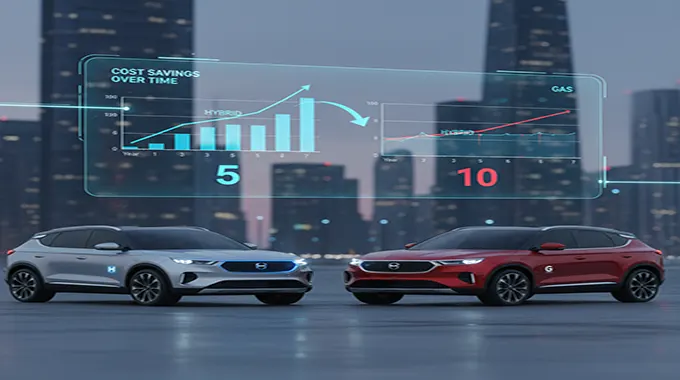
How Many Years to Break Even on a Hybrid vs Gas SUV in 2025?

For years, the “hybrid premium”—the extra cost you pay upfront for an electrified powertrain—meant it could take nearly a decade to see a return on your investment. However, in 2025, that window has shrunk significantly. Between narrower price gaps and more efficient dual-motor systems, the break-even point for a modern SUV is closer than ever.

The Upfront Cost Gap in 2025

The first part of the equation is the initial price difference. In 2025, the average price premium for a hybrid SUV over its internal combustion engine (ICE) counterpart is approximately $1,500 to $2,500.

For example, a 2025 Toyota RAV4 Hybrid starts roughly $1,650 higher than the base gas model when equipped with similar All-Wheel Drive (AWD) features. Other manufacturers, like Honda and Hyundai, have even narrower gaps as they move toward making hybrid powertrains the “standard” for their mid-to-high trim levels.

The Fuel Savings Math

To calculate the …

Most Anticipated Electric Vehicles Coming in 2025 Under $30,000

The dream of an affordable, long-range electric car is no longer a “future” concept—it is the reality of the 2025 showroom. As battery costs continue to plummet and competition from global manufacturers intensifies, several major automakers are launching models that prove you don’t need a luxury budget to go green.

Here are the top budget-friendly EVs dominating the headlines this year.

1. The Tesla “Model 2” (Model Q)

Perhaps the most discussed vehicle in EV history, Tesla’s entry-level hatchback (often referred to as the Model Q or Model 2) is slated to begin production late this year. Aimed squarely at the sub-$30,000 market, this vehicle is expected to leverage Tesla’s “unboxed” manufacturing process to slash costs without sacrificing the tech-heavy experience fans expect.

  • Why it matters: It brings the industry-leading Supercharger network and Autopilot features to a mass-market price point.

2. 2025 Nissan Leaf (The Redesign)

The pioneer of affordable …

Understanding the Importance of Car Workshop Manuals for Vehicle Maintenance

When it comes to maintaining and repairing cars, many owners are not fully aware of the importance and utility of the car workshop manual. This lack of awareness can lead to misconceptions and missed opportunities in taking the best care of their vehicles. The significance of car workshop manuals goes beyond the basic instructions found in a typical owner’s manual, offering a comprehensive guide to every aspect of a car’s functionality and maintenance.

The owner’s manual that accompanies a car at the time of purchase primarily covers basic setup, features, and emergency procedures like changing a flat tire. In contrast, a car workshop manual, also known as a factory service manual, delves much deeper. It provides detailed information about the entire structure of the car, including every component, from screws to gauges, and guidelines for the maintenance and repair of the vehicle. These manuals are specific to the make and …