For years, the “hybrid premium”—the extra cost you pay upfront for an electrified powertrain—meant it could take nearly a decade to see a return on your investment. However, in 2025, that window has shrunk significantly. Between narrower price gaps and more efficient dual-motor systems, the break-even point for a modern SUV is closer than ever.
The Upfront Cost Gap in 2025
The first part of the equation is the initial price difference. In 2025, the average price premium for a hybrid SUV over its internal combustion engine (ICE) counterpart is approximately $1,500 to $2,500.
For example, a 2025 Toyota RAV4 Hybrid starts roughly $1,650 higher than the base gas model when equipped with similar All-Wheel Drive (AWD) features. Other manufacturers, like Honda and Hyundai, have even narrower gaps as they move toward making hybrid powertrains the “standard” for their mid-to-high trim levels.
The Fuel Savings Math
To calculate the break-even point, we look at the average American driving habit: 15,000 miles per year.
- Gas SUV: Averaging 28 MPG combined, at $3.50 per gallon, you spend roughly $1,875 annually.
- Hybrid SUV: Averaging 40 MPG combined, at $3.50 per gallon, you spend roughly $1,312 annually.
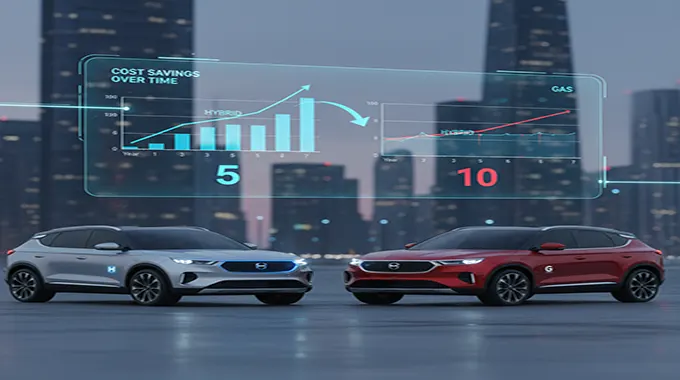
In this scenario, you are saving $563 per year at the pump. If your hybrid premium was $1,650, your break-even point on fuel alone is 2.9 years. Even with a higher $2,500 premium, you reach parity in about 4.4 years.
The “Hidden” 2025 Variables
Beyond the gas pump, several factors in 2025 are accelerating the return on investment:
- Maintenance Advantage: Hybrid SUVs utilize regenerative braking, which significantly reduces wear on brake pads and rotors. In 2025, many hybrid owners find their first brake service occurs years later than gas-only owners.
- Resale Value: Data from late 2024 and early 2025 shows that hybrid SUVs retain roughly 10-15% more value than gas-only models after three years. This “residual value” effectively wipes out the hybrid premium the moment you sell the car.
- City vs. Highway Mix: If you are a “city crawler” or deal with heavy stop-and-go traffic, your hybrid efficiency can jump to 45+ MPG, while a gas SUV’s efficiency plummets. In urban environments, the break-even point can drop to under 2 years.
The Verdict
In 2025, if you plan to keep your SUV for at least three to four years, the hybrid is almost always the superior financial choice. For high-mileage drivers or those in high-traffic metro areas, the “hybrid tax” is recovered almost immediately through lower operating costs and higher trade-in values.
While gas SUVs still make sense for low-mileage rural drivers (under 8,000 miles a year), the hybrid has officially become the “logical middle” for the American family.